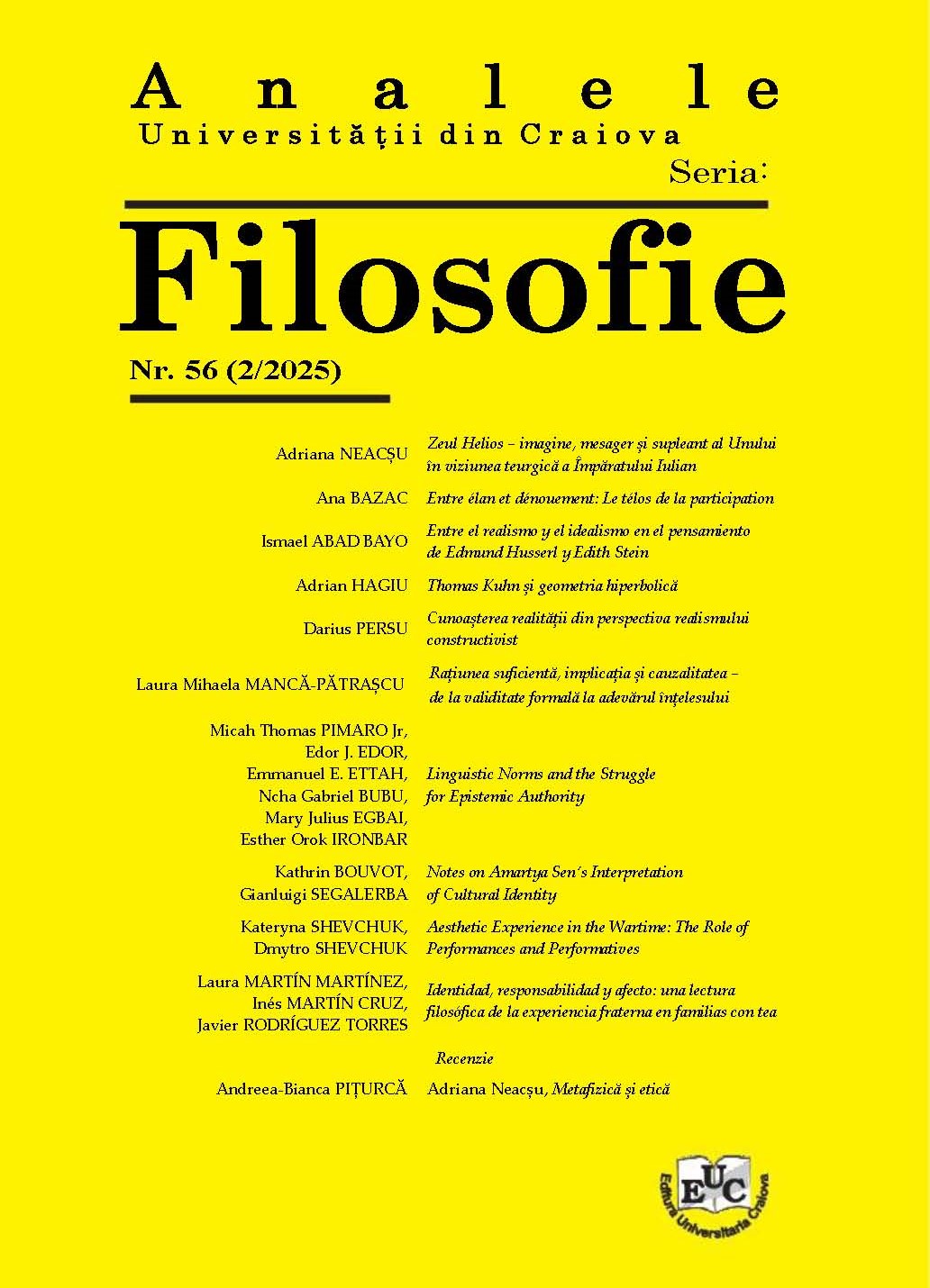
ENTRE EL REALISMO Y EL IDEALISMO EN EL PENSAMIENTO DE EDMUND HUSSERL Y EDITH STEIN
DOI:
https://doi.org/10.52846/afucv.v2i56.114Keywords:
Husserl, Stein, idealism, realism, neokantianism, knowledge, phenomenology, ontology, metaphysics, experience, subject, objectAbstract
The aim of this article is to clarify and delimit the influence of idealism and realism on both Edmund Husserl and his disciple Edith Stein. German philosophical thought at the end of the 19th century and the beginning of the 20th century was strongly influenced by neokantianism of an idealist nature. In the study and reading of Edmund Husserl's works, one notices a certain flirtation, sometimes contradictory, between the realist and idealist currents, to the point where his position dissipates at times. Nevertheless, it is clear that, in the last stage of his career, he leaned towards an idealist position, which caused division among his disciples. As a consequence, two very marked phenomenological currents emerged: the realist and the idealist.
In the case of Edith Stein, it seems clear that she always leaned towards philosophical realism; undoubtedly, when she embraced the scholasticism of Thomas Aquinas. Nevertheless, she does not renounce phenomenology or the influence of and respect for Husserl. We will see, then, in addition to Husserl's intellectual evolution, in which specific philosophical concepts master and disciple take different perspectives affected by a realist and idealist vision.